

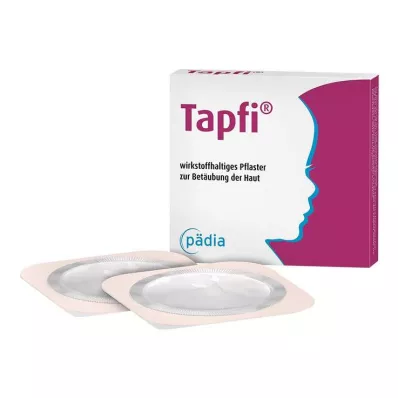
Tapfi 25 mg/25 mg medicated plaster, 2 pcs
TAPFI 25 mg/25 mg wirkstoffhaltiges Pflaster
Manufacturers: Pädia GmbH
PZN: 16739747
Dosage: Pflaster
Content: 2 St
Reward Points: 76
Availability: In stock
$10.93
$9.37
from German pharmacies to your address
Instructions for use for Tapfi 25 mg/25 mg medicated plaster, 2 pcs
Tapfi® 25 mg/25 mg medicated plaster
The plaster for preventive pain reduction
Tapfi® is a plaster containing active ingredients that reduces the pain of needle punctures, such as:B. reduced during vaccinations and minor surgical procedures on the skin.Tapfi® contains a proven active ingredient combination of lidocaine and prilocaine, which briefly anesthetizes the top layer of skin.Since Tapfi® is very well tolerated, it can be used from birth.For many children, vaccination is associated with stress and pain.This is where Tapfi® can help: With the Tapfi plaster, the child can hardly feel the spike.The patch numbs the top layer of skin by temporarily switching off the pain receptors there.Both the puncture pain and the unpleasant feeling of pressure during the injection are effectively reduced.
No prescription is required for this product.
Area of application
Tapfi® contains two active ingredients called lidocaine and prilocaine.These belong to a group of medicines called local anesthetics.Tapfi® works by briefly anesthetizing the surface of the skin.It is applied to the skin before certain medical procedures.This helps eliminate the pain on the skin.However, you may still feel pressure or touch.
Adults, teenagers and children can use Tapfi® to anesthetize the skin before receiving a needle puncture, e.g.B. during an injection or blood draw, or before minor surgical procedures on the skin.
Active ingredients / ingredients / ingredients
1 medicated plaster contains 25 mg lidocaine and 25 mg prilocaine.The other ingredients are: Emulsion: Macrogol glycerol hydroxystearate (Ph. Eur.), Carbomer 974P, sodium hydroxide, purified water.Part of the plaster containing the active ingredient in contact with the skin: Absorbent cellulose disk, coated carrier film (aluminum foil with plastic coating), foam adhesive strip (polyethylene-coated ring with acrylate adhesive).
Contraindications
Tapfi® must not be used if you are allergic to lidocaine or prilocaine, other similar local anesthetics or any of the other ingredients of this medicine.
Dosage
Always use Tapfi® exactly as described or exactly as instructed by your doctor, pharmacist or medical professional.If you are unsure, ask your doctor, pharmacist or nurse.
Where the medicated plaster is applied, how many plasters are used and how long it remains on the skin depends on what it is needed for.Your doctor, pharmacist or healthcare professional will apply the medicated patch or show you how to use it correctly yourself.
Do not use the patch on the following skin areas: cuts, abrasions or wounds, areas of rash or eczema, near the eyes, in the mouth.
Use on the skin before minor procedures (such as a needle puncture or minor skin operations): The plaster containing the active ingredient is stuck to the skin.Your doctor, pharmacist or nurse will tell you where to stick it.The plaster containing the active ingredient is removed immediately before the procedure.
One or more patches are usually applied to adults and adolescents aged 12 and over.For adults and adolescents aged 12 and over, the medicated plaster is applied at least 60 minutes before the procedure.However, do not stick it more than 5 hours before the procedure.
For children, it depends on their age how many medicated plasters are used and how long they are used.Your doctor, pharmacist or nurse will tell you how many medicated plasters you need and when they should be applied.
Duration of action: approx. 1 hour.
Newborns and infants aged 0 - 2 months: A plaster containing active ingredients is stuck to the area of skin to be treated.Duration of action: maximum 1 hour.Only a single dose may be used within 24 hours.Due to its size, the medicated plaster is not suitable for use on certain parts of the body of newborns and infants.
Infants aged 3 - 11 months: Up to two plasters containing active ingredients are stuck to the area of skin to be treated.Duration of action: approx. 1 hour, maximum 4 hours.
Children aged 1 - 5 years: Up to 10 plasters containing active ingredients are stuck onto the skin area to be treated.Duration of action: approx. 1 hour, maximum 5 hours.
Children aged 6 - 11 years: Up to 20 plasters containing active ingredients are stuck to the skin area to be treated. Duration of action: approx. 1 hour, maximum 5 hours.
A maximum of 2 doses as listed above, each 12 hours apart, may be administered within a 24-hour period in children over 3 months of age.Tapfi® can be used in children with neurodermatitis (a skin disease also called "atopic dermatitis"), but the application time is then no more than 30 minutes.
When applying the medicated plaster, it is important that you follow the following instructions exactly: Tapfi® should be applied at least 1 hour before the planned procedure (except for patients with neurodermatitis).If necessary, remove body hair from the relevant skin area before use.The plaster containing the active ingredient must not be cut or otherwise divided.
Use on the skin before removing warts: The patch can be used on children and adolescents with neurodermatitis (a skin disease also called "atopic dermatitis").The usual dose depends on the age of the child and is used for 30 to 60 minutes (30 minutes for children/adolescents with neurodermatitis).Your doctor, pharmacist or nurse will tell you how many patches you should use.
If you have used more patches than you should: If you have used more patches than your doctor, pharmacist or nurse told you, tell them straight away, even if you do not notice any symptoms of illness.Complaints after using too many patches are listed below.The symptoms are unlikely to occur if the product is used as recommended: feeling light-headed or dizzy, tingling of the skin around the mouth and numbness of the tongue, unusual taste, blurred vision, ringing in the ears. There is also a risk of "acute methemoglobinemia" (a problem with blood pigment levels).This is more likely if certain medicines are taken at the same time.When this occurs, the skin turns bluish-gray due to lack of oxygen.In severe cases of overdose, symptoms such as seizures, low blood pressure, slowed breathing, stopping breathing and changes in heartbeat may occur.These effects can be life-threatening.
If you have any further questions about the use of this medicine, talk to your doctor, pharmacist or nurse.
Intake
When applying the medicated patch, it is important that you follow the following instructions exactly: It should be applied at least 1 hour before the planned procedure (except for patients with neurodermatitis).If necessary, remove body hair from the relevant skin area before use.The plaster containing the active ingredient must not be cut or otherwise divided.
Make sure that the area of skin to be anesthetized is clean and dry.Bend back the protruding aluminum wing at the corner of the patch.Now grab the skin-colored side of the plaster with your other hand.Make sure both layers are well separated at the corner before continuing.
Now pull the adhesive surface and protective film apart.Be careful not to touch the white round pillow that contains the active ingredients (lidocaine/prilocaine).
Do not press on the center of the medicated patch.This could result in the emulsion leaking out and the adhesive surface not adhering sufficiently.Press the patch firmly around the edges so that it adheres well to the skin.
The time at which it was applied can be noted on the edge of the medicated plaster.(A ballpoint pen is suitable for this.)
Allow the patch containing the active ingredient to take effect for at least 1 hour (exception: patients with neurodermatitis).For children under 3 months of age, the medicated patch must not be left on for longer than one hour.
Remove the plaster containing the active ingredient after the appropriate exposure time has elapsed.
Patient information
Please talk to your doctor, pharmacist or nurse before using this medicine if you or your child have a rare congenital disease called "glucose-6-phosphate dehydrogenase deficiency" which affects the blood, if you or your child have a problem with the level of the blood pigment methemoglobin in the blood, called "methaemoglobinemia" if you or your child have neurodermatitis (an itchy skin disease, also called "atopic"Dermatitis"), a shorter exposure time may be sufficient. An exposure time of more than 30 minutes can lead to an increased occurrence of local skin reactions.
Avoid getting the medicated emulsion in the eyes as this may cause irritation.If the emulsion accidentally gets into your eye, you should immediately rinse it well with lukewarm water or saline solution (sodium chloride solution).Be careful not to let anything get into your eye until feeling returns.
If you use the product before vaccinations with live vaccines (e.g. tuberculosis vaccinations), you should visit your doctor or nurse again within the specified period to check the vaccination result.
In infants/newborns under 3 months of age, a temporary, clinically insignificant increase in the concentration of the blood pigment methemoglobin in the blood ("methaemoglobinemia") is often observed up to 12 hours after application of the patch.The effectiveness of the patch when taking blood samples from the heel of newborns could not be confirmed in clinical studies.It should not be used in children under 12 months of age who are being treated at the same time as other medicines that affect the concentration of the blood pigment methemoglobin in the blood ("methaemoglobinemia") (e.g. sulfonamides).The preparation should not be used in premature babies.
This preparation has no or negligible influence on the ability to drive and use machines when used in the recommended doses.
Pregnancy
If you are pregnant or breast-feeding, think you may be pregnant or are planning to have a baby, ask your doctor or pharmacist for advice before using this medicine.
Occasional use during pregnancy is unlikely to have adverse effects on the fetus.
The active ingredients (lidocaine and prilocaine) pass into breast milk.However, the amount is so small that there is generally no risk to the child.
Animal studies showed no impairment of male or female reproductive function.
Notes
Tapfi® contains macrogol glycerol hydroxystearate (Ph. Eur.), which can cause skin reactions.
Tapfi® must not be used if you are allergic to lidocaine or prilocaine, other similar local anesthetics or any of the other ingredients of this medicine.
Do not use Tapfi® on the following skin areas: cuts, abrasions or wounds, areas of rash or eczema, near the eyes, in the mouth.
Please do not use this medicine after the expiry date stated on the pack or outer packaging.The expiry date refers to the last day of the specified month.
Medicines Reviews
There are no reviews for this product.
Write a review
Related Products
Popular in Plaster & Bandages

Hansaplast Green & Protect plaster strips (20 pieces)
HANSAPLAST Green & Protect Pflasterstrips
$3.66 $4.58