

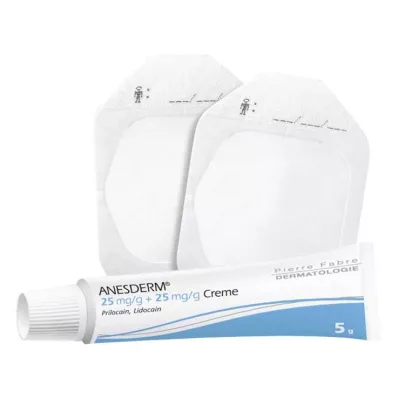


ANESDERM 25 mg/g + 25 mg/g cream + patch, 5 g
ANESDERM 25 mg/g + 25 mg/g Creme + 2 Pflaster
Manufacturers: PIERRE FABRE DERMO KOSMETIK GmbH GB - DUCRAY A-DERMA PFD
PZN: 09071496
Dosage: Creme
Content: 5 g
Reward Points: 44
Availability: Out of stock
$9.21
$6.80
from German pharmacies to your address
Instructions for use for ANESDERM 25 mg/g + 25 mg/g cream + patch, 5 g
ANESDERM® - Tolerable to the skin for a painless medical visit
With ANESDERM®, Pierre Fabre Dermatologie offers an anesthetic cream for the skin before painful procedures.Regardless of whether it is a vaccination, blood draw, injection of a local anesthetic into a sensitive part of the body, laser therapy or a minor surgical procedure such as the removal of a birthmark - ANESDERM® ensures a painless and therefore stress-free treatment.
No prescription is required for this product.
Versatile
The proven active ingredients of ANESDERM® penetrate the skin and make it insensitive to pain after an exposure time of approximately one hour by blocking the transmission of the pain stimulus to the brain.Vaccinations, blood tests or the removal of small skin changes such as molluscs can be carried out painlessly and are no longer frightening with ANESDERM®.
ANESDERM® can also be used on the genital mucosa of adults, e.g.B. for local anesthesia before minor procedures such as the removal of genital warts or the injection of local anesthetics.
Active ingredients / ingredients / ingredients
ANESDERM® contains the active ingredients lidocaine and prilocaine.The cream consists of the following ingredients: prilocaine, lidocaine, carbomer 980, macrogol glycerol hydroxystearate 40, sodium hydroxide solution 10%, purified water.1 g of cream contains 25 mg prilocaine and 25 mg lidocaine.
Mode of action
ANESDERM® belongs to the group of medicines called local anesthetics. ANESDERM® works by briefly anesthetizing the surface of the skin.It is applied to the skin before certain medical procedures.This reduces pain on the skin, but allows pressure and touch sensitivity to remain intact.
Contraindications
The medicine must not be used if you are allergic to lidocaine, prilocaine or similar local anesthetics or any of the other ingredients of the medicine.
Dosage
The proven active ingredients of ANESDERM® penetrate the skin and make it insensitive to pain after an exposure time of approximately one hour by blocking the transmission of the pain stimulus to the brain.Vaccinations, blood tests or the removal of small skin changes such as molluscs can be carried out painlessly and are no longer frightening with ANESDERM®. ANESDERM® can also be used on the genital mucosa of adults, e.g.B. for local anesthesia before minor procedures such as the removal of genital warts or the injection of local anesthetics.
Intake
Where the cream is applied, how much cream is applied and how long it remains on the skin depends on the intended use.Your doctor, pharmacist or nurse will apply the cream to you (or your child) or show you how to apply the cream yourself.The use of the cream on the genitals should be supervised by a doctor or healthcare professional.
The medicine must not be used on the following areas: on cuts, scrapes or other open wounds other than leg ulcers, on a skin rash or eczema, in or near the eye, in the nose, ear or mouth, in the anus region, on the genitals of children.
People who frequently apply or remove the cream should ensure that direct contact with the cream is avoided to prevent the development of hypersensitivity (allergy).The protective membrane of the tube can be pierced using the screw cap.
Use on the skin before minor procedures (e.g. needle puncture or minor skin operations): The cream is applied to the skin in a thick layer.Your doctor, pharmacist or nurse will tell you where to apply the cream.The cream is then covered with a plaster (plastic film).This will be removed shortly before the procedure begins.If you apply the cream yourself, make sure you have been given patches by your doctor, pharmacist or nurse.
The usual dose for adults and adolescents 12 years of age and older is 2 g (grams).For adults and adolescents 12 years of age and older, the cream is applied at least 60 minutes before the procedure (unless the cream is used on the genitals).However, the cream should not be applied more than 5 hours beforehand.For children, the amount to use and exposure time depend on their age.Your doctor, pharmacist or nurse will tell you how much cream to apply and when to apply it.
When applying the cream, it is very important to carefully follow the instructions below: Squeeze a sufficient amount of the cream onto the area of skin where it is needed (e.g. the intended puncture site).Do not rub the cream.Peel off the paper layer from the patch.Remove the protective films from the plaster and carefully cover the cream with the plaster.Avoid the cream leaking out from under the patch.Remove the plastic frame.Press the edges of the patch carefully.Leave the patch on the skin for at least 60 minutes.Your doctor or nurse will remove the patch and cream just before the medical procedure (e.g. just before the needle is inserted).
Use on larger, freshly shaved areas of skin before outpatient procedures (e.g. hair removal): The usual dose is 1 g of cream on a skin area of 10 cm² (10 square centimeters), the exposure time is 1 to 5 hours under a plaster.The medicine should not be used on areas larger than 600 cm² (600 square centimeters, e.g. 30 cm by 20 cm) on freshly shaved skin.The maximum dose is 60 g.
Use on the skin (larger areas) before an inpatient procedure (e.g. split-thickness skin transplant) that requires deeper anesthesia of the skin: The medicine can be used for this purpose in adults and adolescents aged 12 years and older.The usual dose is 1.5 to 2 g of cream on a 10 cm² (10 square centimeters) skin area.The exposure time is 2 to 5 hours under a plaster.
Use on the skin before removing wart-like skin lesions ("molluscs"): The medicine can be used in children and adolescents with the skin disease "atopic dermatitis".The usual dose depends on the age of the child and the exposure time is 30 to 60 minutes (30 minutes for atopic dermatitis).Your doctor, pharmacist or nurse will tell you how much cream to apply.
Application on the skin in the genital area before the injection of locally effective anesthetics: The medicine can only be used for this purpose in adults and adolescents aged 12 years and older.The usual dose is 1 g of cream (1 to 2 g for female genital skin) on a skin area of 10 cm² (10 square centimeters).The exposure time is 15 minutes for male genital skin and 60 minutes for female genital skin, each time under a plaster (unless your doctor recommends a longer period of application).
Use on the genitals before minor skin surgery (e.g. wart removal): The medicine can only be used for this purpose in adults and adolescents aged 12 years and older.The usual dose is 5 to 10 g of cream with an exposure time of 10 minutes.For adolescents weighing less than 20 kg, the maximum dose will be adjusted by your doctor.A plaster is not necessary.The medical procedure will begin immediately afterwards.
Use on leg ulcers before cleaning or removing damaged skin: The usual dose is 1 to 2 g of cream on a 10 cm² area of skin.The maximum dose is 10 g.The cream is applied with an airtight dressing such asB. covered with a plastic film.The exposure time before cleaning the leg ulcer is 30 to 60 minutes.Cleaning is carried out immediately after removing the cream with cotton gauze.The medicine can be used up to 15 times over a period of 1 - 2 months before cleaning leg ulcers.When used on leg ulcers, the tube is intended for single use only.After each treatment of a patient, the tube with any remaining cream must be disposed of.
Patient information
Talk to your doctor or pharmacist before using this product if you or your child suffers from a rare congenital blood disorder called “glucose-6-phosphate dehydrogenase deficiency”.If you or your child have a red blood pigment disorder called “methaemoglobinaemia”.If you or your child suffers from an itchy skin condition called "atopic dermatitis", a shorter exposure time of 15 to 30 minutes may be sufficient.Exposure times longer than 30 minutes may cause certain local reactions to occur, particularly redness at the application site and, in some cases, petechiae and purpura (red patches on the skin).If you are taking certain medicines for cardiac arrhythmias (class III antiarrhythmics such as amiodarone).In this case, the doctor will monitor your heart function. Do not use the medicine on areas of skin with a rash or cuts, scrapes, or other open wounds, except for leg ulcers.If any of these apply to you, talk to your doctor or pharmacist before using the cream.
Due to a possible increased absorption rate on freshly shaved skin, it is very important to adhere to the recommended dosage, area of skin area and exposure time.Avoid contact of the drug with the eyes as eye irritation and chemical burns may occur.However, if your doctor has prescribed the medicine for use near the eyes, you should exercise caution when doing so.If the medicine accidentally comes into contact with the eye, the eye should immediately be thoroughly rinsed with lukewarm water or saline (sodium chloride) solution.Protect the affected eye until sensation returns to avoid any further exposure and inform your doctor.If the medicine is used in children, the child should be closely monitored, regardless of the site of application, to prevent them from self-administering the medicine in their eyes.The cream must not be used on a compromised eardrum.If you use the medicine before vaccination with a live vaccine (e.g. tuberculosis vaccination), you should come back to your doctor or nurse after the specified time to have the success of the vaccination checked.
In newborns and infants under 3 months of age, a transient, clinically insignificant increase in red blood pigment ("methaemoglobinaemia") is generally observed up to 12 hours after use of the drug.Clinical trials have not confirmed its effectiveness in collecting blood from the heel of newborns or providing adequate anesthesia during circumcision.The medicine must not be applied to the genital skin (e.g. penis) and genital mucosa (e.g. into the vagina) of children (under 12 years of age) as there is no sufficient data on the absorption of the active ingredients.The medicine must not be used in infants/newborns under 12 months of age if they are also receiving other medicines that affect the concentration of red blood pigments ("methaemoglobinemia") (e.g. sulfonamides).The medicine must not be used in premature babies with a gestational age of less than 37 weeks as they are at risk of developing high levels of methemoglobin.
Ability to drive and use machines
When used in the recommended doses, the medicine has no or negligible influence on the ability to drive and use machines.
Pregnancy
If you are pregnant or breast-feeding, think you may be pregnant or are planning to have a baby, ask your doctor or pharmacist for advice before using this medicine.
Occasional use of the drug during pregnancy is unlikely to have adverse effects on the unborn child.Do not use the medicine during pregnancy unless your doctor prescribes it because there are insufficient data.
The active ingredients contained in the cream (lidocaine and prilocaine) pass into breast milk.However, the amounts are so small that there is generally no danger to the child.Do not use this medicine if you are breast-feeding unless prescribed by your doctor.
Animal studies have shown no impairment of male or female fertility.
Notes
Contains macrogol glycerol hydroxystearate.Read the package leaflet.For information about risks and side effects, read the package leaflet and ask your doctor or pharmacy.
Please do not use this medicine after the expiry date stated on the pack or outer packaging.The expiry date refers to the last day of the specified month.
Images of ANESDERM 25 mg/g + 25 mg/g cream + patch, 5 g


Medicines Reviews
There are no reviews for this product.
Write a review
Related Products
Popular in Plaster & Bandages



Hansaplast Green & Protect plaster strips (20 pieces)
HANSAPLAST Green & Protect Pflasterstrips
$3.66 $4.58