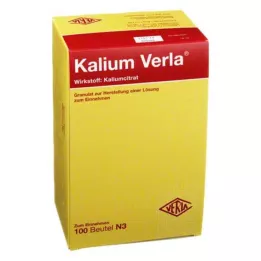
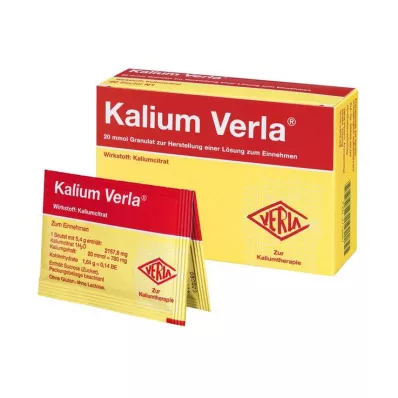
Potassium Verla® granulate bags, 20 pcs
KALIUM VERLA Granulat Btl.
Manufacturers: Verla-Pharm Arzneimittel GmbH & Co. KG
PZN: 07712867
Dosage: Granulat
Content: 20 St
Reward Points: 37
Availability: In stock
$6.90
$5.18
from German pharmacies to your address
Instructions for use for Potassium Verla® granulate bags, 20 pcs
Potassium Verla® granules
Kalium Verla® granules are used to treat potassium deficiency (hypokalemia).This product is available without a prescription.
The granules are stomach-friendly and well tolerated.Its pleasant citrus taste encourages you to drink more.It is also gluten-free, lactose-free and vegan.
Potassium Verla® granules have proven themselves for many years as a reliable medicine in the treatment of potassium deficiency states.The powder has a refreshing citrus taste and can simply be mixed with water to support daily fluid intake.Unlike effervescent tablets, the dissolved powder is not effervescent, making it a good alternative for people who find effervescent tablets unpleasant.The moderate dosage means it can be easily dosed individually and can be taken throughout the day.Kalium Verla® granules only contain organic potassium citrate, which is better tolerated than potassium chloride.
Potassium - Essential for movement and growth
Potassium is the most important quantitative element in cells.Together with sodium, it regulates the bioelectricity of cells, which is essential for the electrical excitability, stimulus generation and stimulus conduction of nerve and muscle cells.Potassium is therefore essential for muscle movements, heart function, blood pressure regulation and concentration processes in the kidneys.It also regulates the osmotic pressure of the cells and is involved in the distribution of water in the organism.Potassium plays another important role in maintaining the acid-base balance.Energy metabolism and growth processes also depend on potassium, which is required, among other things, for the metabolism of glucose and the formation of fatty acids and proteins.
What symptoms are possible with a potassium deficiency?
The diverse functions of potassium make it clear that it is an essential mineral for the organism.A potassium deficiency can manifest itself in various symptoms, including general exhaustion and tiredness, high blood pressure, cardiac arrhythmias, rapid heartbeat and palpitations, sensory disorders such as numbness or tingling, muscle weakness and even symptoms of paralysis, as well as muscle cramps in the calves, toes and soles of the feet.
What causes a potassium deficiency?
Potassium balance depends on four factors: intake, requirement, loss and rate of absorption from the intestine.A deficiency occurs when not enough potassium is supplied, there is an increased need, the body excretes too much potassium due to illness or stress, or the absorption of the mineral into the body is disturbed.
Feed
There are numerous foods that contain a lot of potassium, such as bananas, apricots, tomatoes, potatoes, spinach, lentils and nuts.Dried fruits have particularly high potassium contents, but due to their high sugar content they should only be consumed in small quantities.Fats, oils, white bread, sugar and jam, on the other hand, contain only low potassium levels.A potassium-rich diet with lots of fruits and vegetables is the best way to keep potassium levels in balance.Consuming too little fruit and vegetables can cause a potassium deficiency.
Need
A healthy adult should consume around 4,000 mg of potassium daily.In certain situations, such as physically or mentally demanding work, high levels of sporting activity or during pregnancy and breastfeeding, the body needs more potassium.Due to growth processes, children have a significantly higher potassium requirement than adults in relation to body weight.
Loss
Heavy sweating, such as during physical exertion, extreme heat conditions or in the sauna, can lead to increased loss of potassium.Women during menopause can also experience a potassium deficiency due to sweating.People who are physically active lose potassium through urine and sweat.A potassium deficiency can also occur when taking water medications (diuretics) or laxatives (laxatives).Excessive consumption of licorice can also lead to potassium losses.
Recording
Inflammatory bowel disease can lead to inadequate potassium absorption.In addition, vegetables rich in potassium are often poorly tolerated due to their high fiber content and are therefore only consumed sparingly.A magnesium deficiency can also lead to a potassium deficiency in the cell.
Area of application
Potassium Verla® granules are used to replace potassium in cases of severe potassium depletion (hypokalemia) (serum potassium below 3.2 mmol/l), especially in the case of simultaneous metabolic acidosis (metabolic acidosis), in neuromuscular disorders or cardiac arrhythmias with potassium depletion, in potassium depletion with simultaneous treatment with digitalis, or to prevent potassium depletion in the body (hypokalemia).(Serum potassium below 3.5 mmol/l) in cases of metabolic hyperacidity caused by ketone bodies (ketoacidosis).
Active ingredients / ingredients / ingredients
Ingredients of Kalium Verla® Granules: Active ingredient: potassium citrate.1 sachet contains 2,157.8 mg potassium citrate monohydrate, equivalent to 20 mmol = 780 mg potassium.Other ingredients: sucrose, citric acid, sodium cyclamate, orange flavor.
Contraindications
Kalium Verla® Granules must not be taken if you are allergic to the active ingredient or any of the other ingredients of this medicine or suffer from diseases that are often associated with an increased potassium content in the blood, such as a reduction in body water (dehydration), impaired excretory function of the kidneys, hypoadrenocortical function (Addison's disease), congenital seizure-occurring muscle weakness (Adynamia episodica hereditaria).
Dosage
The dosage depends on the extent of the potassium deficiency.The usual dosage for adults is 1 to 2 sachets (corresponding to 20-40 mmol potassium) 2 to 3 times daily.No more than 2 sachets (corresponding to 40 mmol potassium) should be taken at once and no more than 7 sachets (corresponding to 140 mmol potassium) per day.The contents of one sachet should be taken dissolved in half a glass of water, tea or fruit juice.Kalium Verla® should be taken during or after eating.The intake should be extended to 10 to 15 minutes and should not be taken while lying down.
Intake
Please mix the contents of one sachet in a glass of water, mineral water, tea or fruit juice and drink the entire contents of the glass.The medicine should be taken during or after eating.The intake should be extended to 10 - 15 minutes and should not be taken while lying down.
Patient information
Please talk to your doctor or pharmacist before taking the medicine.Particular caution is required when taking sickle cell anemia, during simultaneous treatment with potassium-sparing diuretics (water pills), aldosterone antagonists, ACE-inhibitors, anticholinergics or potentially kidney-damaging medications (non-steroidal anti-inflammatory drugs - anti-inflammatory drugs - etc.).Before use, electrolyte and acid-base status, heart rhythm and, especially in older patients, kidney function should be checked.These parameters should be monitored initially at shorter intervals and later at longer intervals during treatment.
No special precautions are required regarding the ability to drive or use machines.
Pregnancy
If you are pregnant or breast-feeding, think you may be pregnant or are planning to have a baby, ask your doctor or pharmacist for advice before taking this medicine.There are no known indications of harmful effects during pregnancy or breastfeeding.
Notes
Kalium Verla® active ingredient: potassium citrate.Areas of application: Potassium replacement in the case of severe potassium depletion (hypokalemia) (serum potassium below 3.2 mmol/l), especially in the case of simultaneous metabolic acidosis (metabolic acidosis), in the case of neuromuscular disorders or cardiac arrhythmias in the case of potassium depletion, in the case of potassium depletion with simultaneous treatment with digitalis.Prevention of potassium depletion of the body (hypokalemia) (serum potassium below 3.5 mmol/l) in the case of metabolic acidification caused by ketone bodies (ketoacidosis).Notes: contains sucrose (sugar).