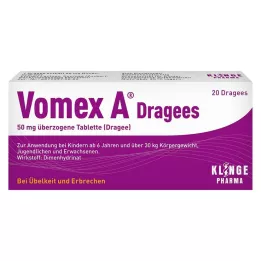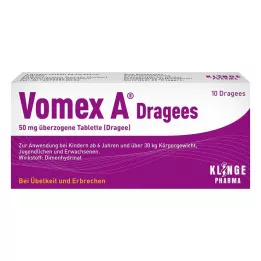
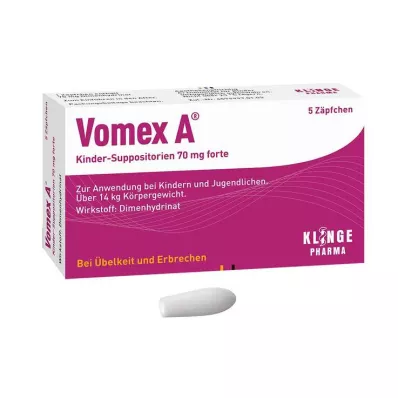
Vomex A® children's suppositories 70 mg forte, 5 pcs
VOMEX A Kinder-Suppositorien 70 mg forte
Manufacturers: Klinge Pharma GmbH
PZN: 11091649
Dosage: Suppositorien
Content: 5 St
Reward Points: 32
Availability: In stock
Attention - refrigerated goods! The item is shipped chilled in a box with ice packs. The buyer assumes the risk of such delivery.
$5.65
$4.23
from German pharmacies to your address
Instructions for use for Vomex A® children's suppositories 70 mg forte, 5 pcs
Vomex A® children's suppositories 70 mg forte
Vomex A® has a quick and long-lasting effect against nausea and vomiting.The Vomex A® children's suppositories 70 mg for children and adolescents are particularly suitable for additional vomiting.From 14 kg body weight to 56 kg body weight.
Whether nausea on the go, due to migraines or a gastrointestinal infection or hormonal-related - nausea can have many causes.Vomex A® works against nausea and vomiting with the active ingredient dimenhydrinate.The effect sets in within 30 minutes and lasts up to six hours.
Dimenhydrinate works directly in a part of the brain called the vomiting center.The dimenhydrinate contained in Vomex A® blocks the histamine receptors in the vomiting center so that signals that trigger nausea and vomiting are not transmitted: the histamine cannot work and the nausea subsides.
Active ingredients / ingredients / ingredients
1 Suppository contains: 70 mg dimenhydrinate.Other ingredients: hard fat.
Area of application
Anti-nausea and vomiting agents from the group of H1 antihistamines.Used to prevent and treat motion sickness, dizziness, nausea and vomiting.No prescription is required for this product.
Note: Dimenhydrinate is not suitable for the sole treatment of nausea and vomiting following drug treatment for cancer (cytostatic therapy).
Contraindications
Must not be used if you are hypersensitive (allergic) to dimenhydrinate, other antihistamines or any of the other ingredients.In acute asthma attacks, glaucoma (angle-closure glaucoma), adrenal gland tumor (pheochromocytoma), disorder of blood pigment production (porphyria), enlargement of the prostate gland (prostatic hyperplasia) with residual urine formation or seizures (epilepsy, eclampsia).
Dosage
Always use the medicine exactly as directed.Please ask your doctor or pharmacist if you are not sure.The dosage of dimenhydrinate should be based on the patient's body weight.For small and light children, a single dose of the lowest dosage in the relevant weight or age group may be enough to relieve the symptoms.
Unless otherwise prescribed by the doctor, the usual dose is: Children weighing 15 to 25 kg: 1 suppository once a day.Children weighing 25 to 40 kg: 1 suppository twice daily.Children weighing more than 40 kg and adolescents aged 14 and over: 1 suppository 2 to 3 times daily.
In addition, the following upper limits should be adhered to: Children aged 6 to 14 receive a maximum of 150 mg dimenhydrinate per day.Adolescents aged 14 and over receive a maximum of 400 mg dimenhydrinate per day.
Unless otherwise prescribed by the doctor, the medicine is only intended for short-term use.If symptoms persist, you should consult a doctor.After 2 weeks of treatment at the latest, your doctor should check whether treatment is still necessary.Please talk to your doctor or pharmacist if you have the impression that the effect is too strong or too weak.
If you have used more than you should: Poisoning with dimenhydrinate, the active ingredient, can be life-threatening.Children are particularly at risk.In the event of an overdose or poisoning, you should always seek advice from a doctor (e.g. poison emergency number) immediately.An overdose is primarily characterized by a clouding of consciousness, which can range from severe drowsiness to unconsciousness.The following signs are also observed: pupil dilation, visual disturbances, accelerated cardiac activity, fever, hot, red skin and dry mucous membranes, constipation, states of excitement, increased reflexes and delusions.In addition, cramps and breathing disorders are possible, which after high doses can lead to respiratory paralysis and cardiovascular arrest.The doctor assesses the severity of the poisoning and determines the necessary measures.
If you forget to use: Do not use a double dose if you forget the previous application, but continue using it as prescribed by your doctor.
If you stop use: Please do not interrupt or stop use without talking to your doctor first.
If you have any further questions about using the medicine, ask your doctor or pharmacy.
Intake
To prevent motion sickness, the first dose is given approx. 1/2 - 1 hour before the start of the journey.To treat nausea and vomiting, doses are given at regular intervals throughout the day. The suppositories should be inserted deep into the rectum.
Patient information
Particular caution in use is required in the case of impaired liver function, cardiac arrhythmias (e.g. rapid heartbeat), potassium or magnesium deficiency, slow heartbeat (bradycardia), certain heart diseases (congenital QT-syndrome or other clinically significant heart damage, in particular circulatory disorders of the coronary arteries, conduction disorders, arrhythmias), simultaneous use of drugs that also prolong the so-called QT-interval in the EKG or lead to oneHypokalemia can cause chronic breathing difficulties and asthma, narrowing at the exit of the stomach (pyloric stenosis) or children under 6 years.In these cases, the medicine may only be used after consulting your doctor.
Drowsiness, memory problems and reduced ability to concentrate can have an adverse effect on the ability to drive or work with machines.This is particularly true after insufficient sleep, when starting treatment and changing medications, and in combination with alcohol.
Pregnancy
Before taking/using any medicines, ask your doctor or pharmacy for advice.
Pregnancy: Tell your doctor if you are pregnant or planning to become pregnant.Dimenhydrinate, the active ingredient in the medicine, can cause premature labor.The safety of use during pregnancy has not been proven.A risk cannot be excluded for dimenhydrinate based on clinical data.You may only use the medicine after consulting your doctor and only if he or she considers it to be absolutely necessary.
Breast-feeding: Tell your doctor if you are breast-feeding.Dimenhydrinate passes into breast milk.The safety of use during breastfeeding has not been proven.Since undesirable effects, such as increased restlessness, on the breast-fed child cannot be ruled out, you should either not use the medicine while breast-feeding or stop breast-feeding while it is being used.
Children: The medicine should not be used in children under 6 years of age.Strength 40 with a lower potency is available for this purpose.
Notes
Keep medicines out of the reach of children.Please do not use this medicine after the expiry date stated on the pack or outer packaging.The expiry date refers to the last day of the specified month.
For information about risks and side effects, read the package leaflet and ask your doctor or pharmacy.
Medicines Reviews
There are no reviews for this product.