
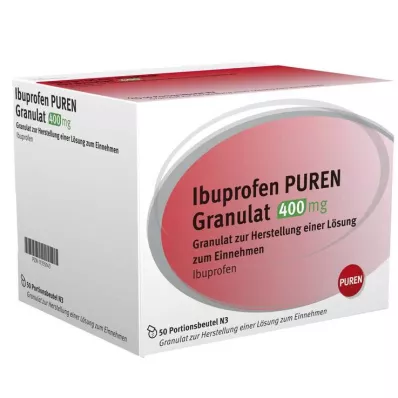
Ibuprofen Puren Granules 400 mg for making an oral solution, 50 pcs
IBUPROFEN PUREN Granulat 400 mg z.Her.e.Lsg.z.Ein.
Manufacturers: PUREN Pharma GmbH & Co. KG
PZN: 11355143
Dosage: Granulat
Content: 50 St
Reward Points: 161
Availability: Out of stock
$60.85
$52.13
from German pharmacies to your address
Instructions for use for Ibuprofen Puren Granules 400 mg for making an oral solution, 50 pcs
Description of the product
Ibuprofen Pure Granules contain the proven and well-tolerated active ingredient ibuprofen.Ibuprofen Pure Granules inhibits the release of the body's own messenger substance prostaglandin and thus has a pain-relieving, anti-inflammatory and fever-reducing effect.Ibuprofen Pure Granules relieves minor pain such as headaches or menstrual pain and reduces fever, which can occur, for example, with flu-like infections.For use in adolescents over 12 years and adults.
Areas of application
Ibuprofen Puren Granules is an anti-inflammatory and analgesic medicine (non-steroidal anti-inflammatory drug/analgesic).Ibuprofen Puren Granules is used for mild to moderate pain and fever.
Active ingredients / ingredients / ingredients
The active ingredient is ibuprofen.1 sachet with 3.067 g of granules contains 400 mg of ibuprofen.The other ingredients are: gelatin, gelatin hydrolyzate, anhydrous citric acid, saccharin sodium 2 water, lemon flavor, highly dispersed silicon dioxide.
Application
The recommended dose is: Adolescents aged 12 and over and adults (over 40kg body weight) take 1 sachet (equivalent to 400 mg ibuprofen) as a single dose.The maximum total daily dose is 3 sachets (corresponding to 1200 mg ibuprofen).If you have taken the maximum single dose, wait at least 6 hours before taking your next dose.
Dissolve the granules in plenty of liquid (e.g. a glass of water).You can drink the solution during or after a meal.For patients who have a sensitive stomach, it is recommended to take Ibuprofen Pure Granules during meals.
Contraindications
Do not take this medicine if you are allergic to ibuprofen or any of the other ingredients of this medicine.If you have had an allergic reaction in the past such as asthma attacks, runny nose, itchy rash, swelling of the lips, face, tongue or throat after taking medicines containing acetylsalicylic acid (such as aspirin) or other medicines for pain and inflammation (NSAR).If you have ever suffered from a stomach/duodenum ulcer or bleeding in the stomach or duodenum in connection with previous use of medicines for pain and inflammation (NSAR).If you have or have had (two or more times) a stomach/duodenum ulcer or bleeding in the stomach or duodenum.If you suffer from severe liver or kidney dysfunction, severe heart failure (heart failure) or coronary heart disease.In the last three months of pregnancy.If you are severely dehydrated (caused by vomiting, diarrhea or insufficient fluid intake).For active bleeding (including cerebral hemorrhage).If you suffer from an unexplained blood disorder.For children under 12 years of age, as this dosage strength is not suitable due to the higher active ingredient content.
Dosage
Always take this medicine exactly as described or as directed by your doctor or pharmacist.Check with your doctor or pharmacist if you are unsure.The lowest effective dose should be used for the shortest duration necessary to relieve symptoms.If you have an infection, consult a doctor immediately if symptoms (e.g. fever and pain) persist or worsen.
The recommended dose is: Body weight (age): > 40 kg (children and adolescents aged 12 and over and adults).Single dose in number of sachets: 1 sachet (equivalent to 400 mg ibuprofen).Max. daily dose in number of sachets: 3 sachets (corresponding to 1200 mg ibuprofen).If you have taken the maximum single dose, wait at least 6 hours before taking your next dose.
Elderly patients: If you are elderly, you should always consult your doctor before taking the medicine as you are more susceptible to side effects, especially bleeding and perforation of the digestive tract, which can sometimes be life-threatening.Your doctor will advise you accordingly.
Impaired kidney or liver function: If you suffer from impaired kidney or liver function, you must always consult your doctor before taking the product.Your doctor will advise you accordingly.
Do not take ibuprofen for more than 4 days without medical or dental advice.Please talk to your doctor or pharmacist if you have the impression that the effect is too strong or too weak.
If you take more than you should: Take the medicine according to your doctor's instructions or according to the dosage instructions given.If you feel that you are not getting sufficient pain relief, do not increase the dosage yourself, but ask your doctor.If you have taken more ibuprofen than you should, or if children have accidentally taken the medicine, always contact a doctor or local hospital for an assessment of the risk and advice on further treatment.Symptoms of overdose may include nausea, stomach pain, vomiting (possibly with blood), or diarrhea.Headaches, ringing in the ears, confusion, eye tremors, and gastrointestinal bleeding may also occur.At high doses, drowsiness, chest pain, heart palpitations, fainting, agitation, coma, convulsions (especially in children), weakness and dizziness, blurred vision and visual disturbances, liver and kidney dysfunction, blood in the urine, drop in blood pressure, freezing, breathing problems, blue discoloration of the lips, tongue and fingers and increased bleeding may occur.In asthmatics, asthma may worsen.There is no specific antidote.If you suspect an overdose of the medicine, please notify your doctor.This can decide on any necessary measures depending on the severity of the poisoning.
If you forget to take a dose: If you forget to take a dose, do not take more than the usual recommended amount at the next dose.
If you have any further questions about using the medicine, contact your doctor or pharmacist.
Intake
Dissolve the granules in plenty of liquid (e.g. a glass of water).You can drink the solution during or after a meal.For patients who have a sensitive stomach, it is recommended to take the medicine with meals.
Patient information
The following describes when you should only use this medicine with particular caution under certain conditions (i.e. at longer intervals or in a reduced dose and under medical supervision).Please consult your doctor about this.This also applies if this information was previously true for you.
Please talk to your doctor or pharmacist before taking this medicine if you suffer from systemic lupus erythematosus (SLE) or another autoimmune disease.If you have certain congenital blood formation disorders (e.g. acute intermittent porphyria).If you have chronic intestinal inflammation, such as inflammation of the colon with ulcers (ulcerative colitis), inflammation of the digestive tract (Crohn's disease) or another stomach or intestinal disease.If you have a blood disorder.If you have a blood clotting disorder.If you suffer from allergies, hay fever, asthma, chronic nasal mucous membrane swelling, polyps or chronic obstructive diseases of the respiratory tract, as the risk of narrowing of the airways (bronchospasm) is greater.If you suffer from poor circulation in your arms or legs.If you have liver, kidney or heart disease or high blood pressure.If you have recently had a major surgical procedure.In the first six months of pregnancy.If you are breastfeeding.If you have an infection - see “Infections” below".
You should discuss your treatment with your doctor or pharmacist before taking this medicine if you have heart disease, including heart failure and angina (chest pain), or have had a heart attack, bypass surgery, peripheral arterial disease (circulation problems in the legs or feet due to narrowed or blocked arteries), or any type of stroke (including mini-stroke or transient ischemic attack ("TIA")).have high blood pressure, diabetes or high cholesterol, or a family history of heart disease or stroke, or if you are a smoker.
Simultaneous use of ibuprofen with other non-steroidal anti-inflammatory drugs (NSAR), including so-called COX-2 inhibitors (cyclooxygenase-2 inhibitors), should be avoided.Side effects can be reduced by using the lowest effective dose for the shortest period of time necessary to control symptoms.
Older patients are more likely to experience side effects after using NSAR , especially bleeding and perforations in the stomach and intestines, which can be life-threatening under certain circumstances.Therefore, particularly careful medical monitoring is required in older patients.
Bleeding of the gastrointestinal tract, ulcers and perforations (perforations): Bleeding of the gastrointestinal tract, ulcers and perforations, including fatal outcomes, have been reported among all NSAR .They occurred with or without previous warning symptoms or a history of serious gastrointestinal events at any time during therapy.The risk of developing gastrointestinal bleeding, ulcers and perforations is higher with increasing NSARdose, in patients with a history of ulcers, especially with the complications of bleeding or perforations, and in elderly patients.These patients should begin treatment at the lowest available dose.For these patients, as well as for patients who require concomitant therapy with low-dose acetylsalicylic acid (ASA) or other drugs that may increase the risk of gastrointestinal diseases, combination therapy with drugs that protect the gastric mucosa (e.g. misoprostol or proton pump inhibitors) should be considered.If you have a history of gastrointestinal side effects, especially if you are older, you should report any unusual abdominal symptoms (especially gastrointestinal bleeding), especially at the beginning of therapy.Caution is advised if you are also receiving medicines that may increase the risk of ulcers or bleeding, such as:B. oral corticosteroids, anticoagulant medications such as warfarin, selective serotonin reuptake inhibitors, which are used, among other things, to treat depressive moods, or platelet aggregation inhibitors such as ASA.If you experience gastrointestinal bleeding or ulcers, treatment should be discontinued.
Serious skin reactions have been reported in association with treatment with ibuprofen.If you develop a skin rash, mucous membrane lesions, blisters or other signs of allergy, you should stop treatment with ibuprofen PUREN and seek medical attention immediately, as these may be the first signs of a very serious skin reaction.See “Side effects” category".
Anti-inflammatories/pain relievers such as ibuprofen may be associated with a slightly increased risk of a heart attack or stroke, especially when used in high doses.Do not exceed the recommended dose or treatment duration (4 days)!If you have heart problems or a previous stroke, or think you may be at risk of these conditions (for example, if you have high blood pressure, diabetes or high cholesterol, or are a smoker), you should discuss your treatment with your doctor or pharmacist.
Ibuprofen can cause kidney dysfunction, even in patients who have not had it before.They can manifest themselves in swelling of the legs and can even lead to cardiac dysfunction or high blood pressure in predisposed patients.Ibuprofen can cause damage to the kidneys, especially in patients who already have kidney, heart or liver disease or are taking diuretics or ACE-inhibitors, or in elderly patients.However, once ibuprofen treatment is stopped, it is generally reversible.If ibuprofen is given for a long time, regular monitoring of liver values, kidney function and blood counts is necessary.
The medicine may mask signs of infection such as fever and pain.Therefore, it is possible that ibuprofen may delay adequate treatment of the infection, which may lead to an increased risk of complications.This has been seen in bacterial pneumonia and bacterial skin infections associated with chickenpox.If you take this medicine during an infection and your infection symptoms persist or worsen, consult a doctor immediately.
If you take ibuprofen before surgical procedures, you should consult or inform your doctor or dentist.
Severe acute hypersensitivity reactions (e.g. anaphylactic shock) are very rarely observed.At the first signs of a severe hypersensitivity reaction after taking ibuprofen, therapy must be discontinued.Medically necessary measures appropriate to the symptoms must be initiated by specialists.
The use of ibuprofen should be avoided during a chickenpox infection (varicella infection).
With long-term and high-dose use of painkillers, headaches may occur, which should not be treated with increased doses of the drug.Habitual use of painkillers can cause permanent damage to the kidneys with the risk of kidney failure.Ibuprofen may mask signs or symptoms of infection (fever, pain, and swelling) and may temporarily increase bleeding time.Ibuprofen can reduce your chance of becoming pregnant.If you are planning a pregnancy or are having trouble becoming pregnant, contact your doctor.
Please note the information under the “Contraindication” category".
Ibuprofen generally has no influence on the ability to drive or use machines.Since central nervous side effects such as tiredness, drowsiness, dizziness and visual disturbances can occur when using ibuprofen in higher doses, the ability to react may be changed in individual cases and the ability to actively participate in road traffic and operate machines may be impaired.This applies to an even greater extent when combined with alcohol.You can then no longer react quickly and specifically enough to unexpected and sudden events.In this case, do not drive a car or other vehicles!Do not operate any tools or machines!Do not work without a secure hold!
Pregnancy
If you are pregnant or breast-feeding, think you may be pregnant or are planning to have a baby, ask your doctor or pharmacist for advice before taking this medicine.
Pregnancy: The medicine must not be taken during the last three months of pregnancy as it can cause significant heart, lung and kidney problems in the unborn child.If it is used towards the end of a pregnancy, it can cause bleeding in both the mother and the child and weaken contractions and thus prolong the birth process.You should only use ibuprofen during the first six months of pregnancy on the advice of a doctor and only if absolutely necessary.
Breast-feeding: Ibuprofen only passes into breast milk in very small amounts, so that if used for a short period of time, interrupting breast-feeding will usually not be necessary.However, if prolonged use is prescribed, early cessation of breastfeeding should be considered.
Fertility: This product belongs to a group of medicines (NSAR) that may affect fertility in women.This effect is reversible (reversible) once the drug is discontinued.
Notes
No prescription is required for this product.For information about risks and side effects, read the package leaflet and ask your doctor or pharmacy.If you have pain or fever, do not use it for longer than stated in the package leaflet without medical advice!
Please do not use this medicine after the expiry date stated on the pack or outer packaging.The expiry date refers to the last day of the specified month.
If you take Ibuprofen Pure Granules before surgical procedures, you should consult or inform your doctor or dentist.With prolonged use of painkillers, headaches may occur, which should not be treated with increased doses of the drug.Habitual use of painkillers can cause permanent damage to the kidneys with the risk of kidney failure (analgesic nephropathy).
Medicines Reviews
Write a review
Related Products


Angelica balm & Thyme balm with myrtle children's set, 40 g
ENGELWURZBALSAM & Thymianbalsam m.Myrte Kinder Set
$34.28
Popular in Pain & Inflammation

Voltaren pain gel forte 23.2 mg/g gel with diclofenac, 150 g
VOLTAREN Schmerzgel forte 23,2 mg/g
$23.81 $36.21

Voltaren pain gel forte 23.2 mg/g gel with diclofenac, 100 g
VOLTAREN Schmerzgel forte 23,2 mg/g
$19.67 $28.11


Voltaren pain gel 11.6 mg/g gel, 180 g
VOLTAREN Schmerzgel 1,16 % mit Komfort-Verschlus
$20.90 $30.65