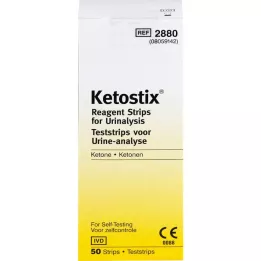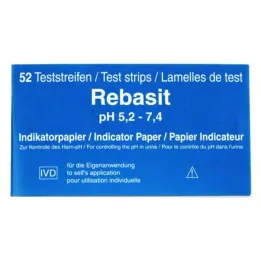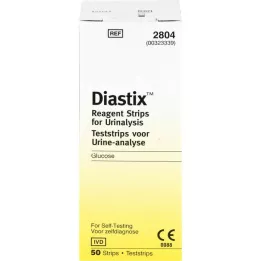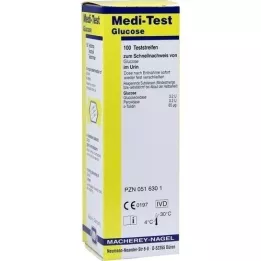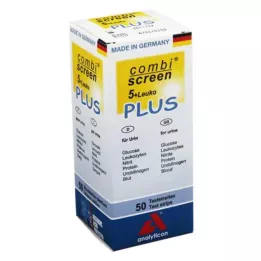
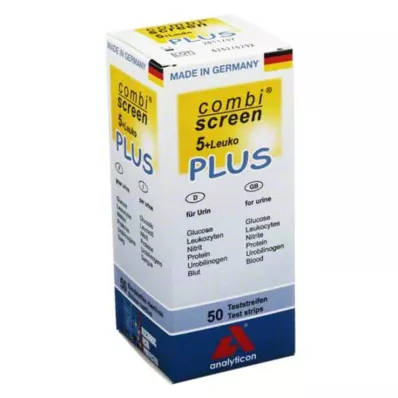
Combiscreen 5 + Leuko Plus Tes, 50 pcs
COMBISCREEN 5+Leuko Plus Teststreifen
Manufacturers: ANALYTICON Biotechnologies AG
PZN: 04809916
Dosage: Teststreifen
Content: 50 St
Reward Points: 197
Availability: In stock
$24.22
from German pharmacies to your address
Instructions for use for Combiscreen 5 + Leuko Plus Tes, 50 pcs
Product features
Combi-Screen Plus is a test system for in-vitro diagnostics.It is used to quickly determine various parameters in urine, including ascorbic acid, bilirubin, blood, glucose, ketone, leukocytes, nitrite, pH, protein, specific gravity and urobilinogen.The combination of parameters on the test strip can be found on the packaging.
Application
The Combi-Screen Plus rapid test is used for the diagnosis and early detection of diabetes, liver and hemolytic diseases, metabolic disorders and diseases of the urogenital tract.
Implementation
Only well-mixed, uncentrifuged urine that has not stood for longer than 4 hours should be used for the test.The first urine in the morning is ideal.The sample should be protected from light.If measurement cannot be carried out immediately, the sample should be stored at 2 - 4°C and warmed to room temperature (15°C - 25°C) before use.Collection vessels must be clean and free of disinfectants or detergent residues.Preservatives should not be added.
The reaction zones of the test strips should not be touched.Only the required number of test strips should be removed and the pack immediately resealed tightly with the original stopper.The test strip should be dipped briefly (approx. 2 seconds) into the urine sample so that all test areas are wetted.Excess urine should be wiped off over the edge of the strip on the edge of the collection container or onto absorbent paper.
During the incubation period, the test strip should be kept horizontal to avoid interference between the reaction zones.The reaction colors should be compared with the color scale after 60 seconds (leukocytes after 60 - 120 seconds).Discoloration that only occurs at the edge of the test fields or more than 2 minutes after the start of the test is irrelevant.The visual evaluation should be carried out in diffuse daylight.
Clinical significance, test principles, expected values, limits
Ascorbic acid: The test determines ascorbic acid (vitamin C) in the urine.The presence of ascorbic acid is indicated by a change from gray-blue to orange.Concentrations from 5 - 10 mg/dl or 0.6 - 1.1 mmol/l ascorbic acid are displayed.
Bilirubin: The test is used to determine bilirubin in the urine, which is used to diagnose liver and biliary diseases.Values of 0.5 mg/dl or more lead to a reddish-orange peach color and indicate the early stages of liver disease.
Blood: The test determines occult blood in the urine, which can indicate diseases of the genitourinary area and kidneys.From a concentration of approximately 25 erythrocytes/pl or higher, no false negative results are normally observed.
Glucose: The test is used to determine glucose in the urine, which is used to diagnose and treat disorders of carbohydrate metabolism such as diabetes mellitus and hyperglycemia.Concentrations of 40 mg/dl (2.2 mmol/l) or more glucose are displayed.
Ketone: The test detects ketone bodies in urine, which are used to diagnose ketoacidosis and to treat and control diabetes patients.Concentrations from 5 mg/dl (0.5 mmol/l) acetoacetic acid or 50 mg/dl (8.6 mmol/l) acetone are displayed.
Leukocytes: The test determines leukocytes in the urine, which can indicate inflammation of the kidneys or the urogenital area.Concentrations from 10 - 20 leukocytes/pl are displayed.
Nitrite: The test determines nitrite in the urine, which can indicate bacterial infections of the urogenital area.Concentrations from 0.05 - 0.1 mg/dl (6.5 - 13 pmol/l) nitrite are displayed.
pH: The test determines the pH value in the urine, which is used to evaluate the acidity or alkalinity of the urine.Persistently high pH values indicate an infection of the urogenital area.
Protein: The test determines proteins in the urine, which are used to diagnose and treat kidney disease.Concentrations of approximately 15 mg/dl albumin are displayed.
Specific Gravity/Density: The test determines the density of urine, which is used to monitor kidney function and to generally assess the concentration of the urine sample.The test allows urine density to be determined between 1.000 and 1.030.
Urobilinogen: The test determines urobilinogen in urine, which is used to diagnose liver diseases and increased hemoglobin breakdown resulting from hemolytic diseases.Concentrations from 1 - 2 mg/dl urobilinogen are displayed.
Effective ingredients
Ascorbic acid: 2,6-dichlorophenolindophenol 0.7%
Bilirubin: diazonium salt 3.1%
Blood: Tetramethylbenzidine dihydrochloride 2.0%, isopropylbenzene hydroperoxide 21.0%
Glucose: glucose oxidase 2.1%;peroxidase 0.9%;o-Tolidine hydrochloride 5.0%
Ketone: Nitroprusside sodium 2.0%
Leukocytes: carboxylic acid esters 0.4%;Diazonium salt 0.2%
Nitrite: Tetrahydrobenzo[h]quinolin-3-ol 1.5%, sulfanilic acid 1.9%
pH: methyl red 2.0%;Bromothymol blue 10.0%
Protein: Tetrabromophenol blue 0.2%
Specific gravity: Bromothymol blue 2.8%
Urobilinogen: diazonium salt 3.6%
Durability
Test strips should be protected from sunlight and moisture.The can should be kept cool and dry at a storage temperature of 2°C - 30°C.If stored properly, the test strips will last until the printed expiry date.
Notes
In principle, a definitive diagnosis cannot be made on the basis of individual test strip results, but rather in conjunction with other medical findings.The effect of medications or their metabolites on the test is not known in all cases.In case of doubt, it is therefore recommended to repeat the test after stopping the medication.However, the medication may only be discontinued following instructions from the treating doctor.
Due to the non-constant composition of urine, the reaction conditions cannot always be the same, so that intensity and color can vary in rare cases.When performing reflectometric evaluation, the detailed instructions for use of the device should be observed beforehand.Due to the different spectral optical properties of the human eye and the measuring unit of the devices, there is not always an exact match between visually and instrumentally determined results.
When handling test strips, the general working regulations for the laboratory must be observed.For in vitro diagnostic use only.For trained personnel only - not for personal use!Avoid swallowing and contact with eyes and mucous membranes.Keep out of the reach of children.Each laboratory should create its own quality control standards.
This leaflet was last revised in March 2016.
Source: Information in the package insert
As of: 01/2024
No prescription is required for this product.
Medicines Reviews
There are no reviews for this product.