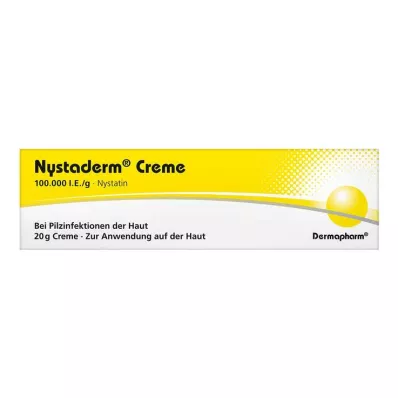


Nystaderm cream, 20 g
NYSTADERM Creme
Manufacturers: DERMAPHARM AG
PZN: 03936593
Dosage: Creme
Content: 20 g
Reward Points: 54
Availability: In stock
$8.76
$6.52
from German pharmacies to your address
Instructions for use for Nystaderm cream, 20 g
Nystaderm® cream for yeast infections of the skin
Nystaderm® Cream is an antifungal agent that is specifically used for skin infections caused by yeast fungi such as Candida spp.is used.It is particularly suitable for diaper candidiasis as it has neither a greasy nor drying effect.The cream is easy to apply and does not require a prescription, so it is available in pharmacies.It should be applied thinly to the affected skin areas 2 to 4 times a day and rubbed in lightly.
Nystaderm® cream is free of silicones, fragrances, dyes, parabens and BHT.No prescription is required for this product.
Area of application
Nystaderm® Cream is used for proven nystatin-sensitive yeast infections of the skin, especially if Candida spp.are involved, such as diaper candidiasis.The active ingredient nystatin has a specific effect against saprophytic and parasitic yeast fungi, especially against Candida species.At low and medium doses, nystatin inhibits the spread of pathogens, while high doses kill them.The effect of nystatin depends on the germ density, so if the germ density is unknown, the maximum dosage should always be used.
The therapeutic applicability and biological availability of nystatin depend not only on the active ingredient, but also on the choice of dosage form and the other suitable ingredients.
Active ingredients / ingredients / ingredients
Nystaderm cream contains the following ingredients:
100000 IE Nystatin
Cetyl alcohol (excipient)
Glycerol monostearate (excipient)
Paraffin, thick (excipient)
Polyoxyethylene (100) monostearate (excipient)
Polyoxyethylene (40) monostearate (excipient)
Propylene glycol (excipient)
Sorbitan sesquioleate (excipient)
Water, purified (excipient)
Methyl 4-hydroxybenzoate (excipient)
Contraindications
If you are known to be hypersensitive to any of the above ingredients, the product should not be used.
Dosage
The usual dose of Nystaderm® cream is to apply a thin layer to the affected skin areas 2 to 4 times a day and rub in lightly.In severe cases, hourly application may prove useful.The preparation should be applied for about 6 days until the disease subsides.To ensure complete therapeutic success, treatment should be continued for another 8-10 days.
Intake
Apply the cream thinly to the affected skin areas and rub in lightly.
Patient information
There is no experience with regard to impairment of the ability to drive and use machines.
Pregnancy
Nystatin, the active ingredient of the preparation, is hardly absorbed in therapeutic doses after oral administration, through the intact skin or through the mucous membranes.Nystatin does not cross the placenta and is not expected to pass into breast milk.The medicine can be used during pregnancy and breastfeeding.Before taking/using any medicines, ask your doctor or pharmacy for advice.
Notes
In the case of fungal infections, all affected areas must be treated in order to prevent new diseases that arise from untreated fungal foci.
Candida mycosis - a yeast fungus as a common cause of diaper rash
In many cases, the cause of diaper rash is candida mycosis - a fungal infection caused by yeast fungi such as Candida albicans.When the diaper rubs against the baby's skin, the protective barrier is disrupted and the yeast can penetrate the irritated skin, spread and show up as diaper thrush.
Candida-related wind eczema can also develop if your baby ingests yeast through the mouth.These can initially trigger oral thrush, which appears in the form of spotty, whitish to yellowish deposits on the mucous membrane, lips, tongue or cheeks.If the fungus spreads through the gastrointestinal tract, it can cause diaper thrush.
Diaper rash: recognizing symptoms
To help your baby, you should be able to recognize and classify the symptoms of candida-related diaper rash in order to treat it properly.A diaper rash is characterized by the following symptoms: red and sore skin, weeping blisters, swollen skin and affected areas that hurt when touched.If it is unclear whether the trigger is a skin fungus or the rash has other causes, you should have the diagnosis confirmed by a doctor.
Frequently Asked Questions & Answers
What is Nystaderm® and what is it used for?
Nystaderm® is a medicine used to treat fungal infections.It contains the active ingredient nystatin, which is effective against yeast fungi.The active ingredient damages the outer covering, the so-called cell membrane, of fungi.This therefore loses some of its functions, cell components escape and the cell can dissolve.Depending on the active ingredient concentration, the growth and reproduction of the fungi is inhibited or killed directly.
In which dosage forms is Nystaderm® available?
Nystaderm® can be administered in different dosage forms:
Nystaderm® Paste is used for skin infections with nystatin-sensitive yeasts such as diaper rash.
Nystaderm® Cream is used for proven nystatin-sensitive yeast infections of the skin when neither a greasy nor drying component is desired, especially with the involvement of Candida spp., such as:B. diaper candidiasis.
Nystaderm® oral gel is used for nystatin-sensitive yeast infections of the oral cavity (oral thrush).
Nystaderm®-S is used for nystatin-sensitive infections of the oral cavity (oral thrush), the pharynx and the esophagus as well as for the topical intestinal treatment of proven nystatin-sensitive yeast infections and for colonization prophylaxis of the gastrointestinal tract, especially in children and infants.
Does Nystaderm® require a prescription?
Nystaderm® paste, cream, suspension and oral gel do not require a prescription and can be purchased in a pharmacy without a doctor's prescription.No prescription is required for this product.
When should Nystaderm® not be used?
Nystaderm® must not be used if you are hypersensitive to the ingredients.In babies born prematurely, the medicine may only be used after consulting a doctor or under medical supervision.If you are pregnant or breastfeeding, you should contact your doctor.Various considerations play a role in whether and how the medicine can be used during pregnancy and breastfeeding.
How can you prevent diaper rash?
There is hardly any way to completely rule out diaper rash.But some measures can help prevent the disease:
Frequent diaper changes: Change your baby's diaper as often as possible, ideally immediately after he or she has urinated or had a bowel movement.This prevents urine and stool from irritating the skin.
Cleaning: Gently but thoroughly clean your baby's diaper area with each diaper change.Avoid harsh soaps and instead use water and a mild soap or special baby wipes.
Drying: After cleaning, allow your baby's skin to dry before putting on a new diaper.Moisture can promote the growth of bacteria and fungi that can cause diaper rash.
Using barrier creams: Creams or ointments that contain zinc oxide, for example, can protect your baby's skin from moisture.Apply the cream generously to the entire diaper area.
Loose-fitting diapers: Make sure diapers fit loosely to allow airflow and minimize friction.
Diaper-free times: If possible, leave your baby without a diaper for some time a day to allow the skin to breathe.
If you notice signs of skin irritation, act immediately: If you notice redness or other signs of skin irritation, act immediately to prevent diaper rash.
Despite all precautions, diaper rash can occur.If your baby shows signs of diaper rash, you should see a doctor.
Medicines Reviews
There are no reviews for this product.